After the death of Goce Delchev and the defeat of the Ilinden - Preobrazhenie Uprising, which was drawn in blood, Yavorov went through a deep crisis. Horrified by the "fearful Macedonian reality", the terrors lived through, the loss of friends, the collapse of his patriotic dreams.
He found in creative work an exit from his painful condition. Gone through from revolutionary activities to poetical contemplation, he created his
"Rebel Songs", the book
"Goce Delchev" and the volume of poetry
"Insomnias".
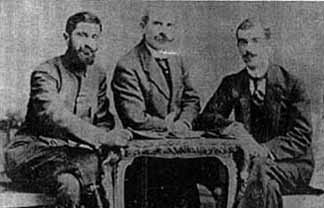
In 1908 Yavorov joined once again the fight for the freedom of captive Macedonia. At the Kyustendil Congress of the I.M.R.O. he was elected, together with d-r Tatarchev and Hristo Silyanov as an adviser of the foreign representation in Sofia. Among the prominent revolutionary functionaries participating at the Congress was also Todor Alexandrov as a delegate from Skopie revolutionary district. To Yavorov was assigned as a task the editorship of the newspaper "Ilinden" as he was already a well-known publicist after the issue of the revolutionary edition "Svoboda ili smrt" ("Freedom Or Death") and his participation in the newspapers "Delo" and "Avtonomia". The main purpose of the newspaper "Ilinden" was to reflect quickly and correctly the political events in Bulgaria, allowing thus the functionaries in the interior of Macedonia to conform their tactics to the situation and to the use the "opportune moment".
Yavorov's functions as a foreign representative in Sofia put him in a continuous connection with Todor Alexandrov who was trying hard to achieve virtually what the pages of the newspaper were proclaiming. Those common aims pursued were to reinforce the Organization. To strengthen the faith of the people therein. To persuade that fighting for the freedom one must count only on his own strength. To make of maximum use the controversies among the Great Powers. To point the attention towards the internal situation in Turkey and towards the aggressive intentions of chauvinist Serbia and Greece that was raving about the Byzantine Empire.
Yavorov's file in the Central State Archive keeps more than 40 letters, postcards and telegrams sent by Todor Alexandrov to Yavorov, which were used to assign to the latter missions that he as a foreign representative had to fulfil. He was required to provide armaments, dynamite, bombs, explosives and related elements and to send them to the interior where they would be used for sabotage actions. To recruit and equip volunteers. To distribute financial aid to Macedonian functionaries who came in Sofia. To issue certificates. To procure for the medical treatment of injured rebels. To relieve the hard situation of the refugees uninterruptedly coming from Macedonia and the Odrin region. The boundless trust that I.M.R.O. and Todor Alexandrov had in the poet is shown by the fact that to Yavorov were entrusted the cash-fund, the whole archive of the Organization and the seals of the Central Committee and Skopie revolutionary district. He was also assigned to provide the subscription to the newspapers "Mir", "Vecherna Poshta" and "Dnevnik".
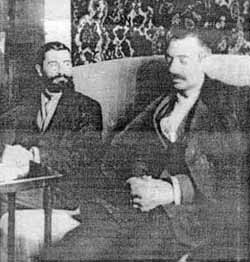
The long-lasting common work, the identical ideological positions, the common cultural interests brought closer both devoted activists of the Macedonian revolutionary movement creating thus between them an enduring friendship.
The fatal night of November 30. 1913 came. During his inhuman sufferings the semiblind author of "Rebel Cravings" found the true compassion of the Macedonian functionaries. At a moment when the whole society turned away from him and only few devoted friends remained beside him, the revolutionaries were constantly trying to ease his pain and to support him materially. However, the best consolation and moral support Yavorov found in his legendary friend Todor Alexandrov who was attempting with his delicacy, literary sense and great culture to encourage the poet, to enhearten him for creation and to inspire him with power to live. Although the fatal solution came. On October 16. 1914 Yavorov concluded the last act of his personal tragedy. This time the bullet accomplished its mission with faultless precision. The poison taken in advance was completely useless.
But who, after all, gave Yavorov the lethal weapon? The answer is behind a veil of secret. A lot of speculations were made and everybody tried to reach the truth his own way. Danail Krapchev, one of the poet's trusted friends, wrote in his memories: "Who gave him the revolver - I don't know. Perhaps Todor Alexandrov." Krapchev's doubt was transmitted by some contemporaries as his already firm conviction that Todor Alexandrov provided Yavorov with the gun. This guesswork laid down deep in people's mind, with the time became categorical and was believed to be indisputable truth.
The end of the legend that Todor Alexandrov gave Yavorov the gun was put by the memories of Milan Matov published several years ago. Therein is written that it was done by the rebel Nikola Gulev, son of the famous Macedonian revolutionary Pitu Gulev. Matov's confession is touching and convincing with its honesty. He wrote: "I am standing in front of the grave, soon I'll be 87 years old... The truth - who gave Yavorov the gun is the following:
At a meeting, after Peyo's suicide, the rebel, bodyguard of Todor Alexandrov, Nikola Gulev ... confessed to me:
- I, dear Milan, am very guilty and I cannot forgive myself how did I do such mistake. It is a big burden to me and I want to confess it to you in order to get relieved. One evening Todor sent me to bring Yavorov a pack of cigarettes. I found him on his own. He invited me to sit down. We began to talk about the Organization. Then he asked me, if I had an excessive gun, to give it to him as a favour for a short period, he would give it back afterwards. I was young, I was caught by the lie and gave him immediately my small gun. He was very satisfied and thanked me. I was also happy because I was able to do a favour to the great poet and Todor's closest friend. How could I understand what a fatal mistake I had committed! When I came back to Todor I proudly announced that I gave Yavorov my gun. He bristled up and railed at me in such manner that I was frozen on my place. I had never seen him so angry. I realized my mistake was really huge.
- What have you done, Kolyo? Do you know why did Peyo take your gun? He is asking since long time different comrades to do him a favour because he was afraid from somebody. And indeed he was looking for a weapon for suicide... How could it not cross your mind, Kolyo?
I could not wait for Todor telling me more. I ran back to Yavorov's house to ask my gun back, but his landlady told me he went out with his brother. I came back to Todor and I was feeling so guilty that I wasn't able to find a place for myself. He understood how huge my pain is and promised to visit Yavorov in the morning and try to recover the gun. On the next day, about 10 o'clock in the morning, he went. He returned at noon very thoughtful and preoccupied. I was standing in the backyard, he passed me by but said not a single word. Obviously, he didn't manage to get it back. The same evening Yavorov committed suicide." ("Memories about P.K. Yavorov", compiler M. Markovska, S. 1989, p. 125-126)
Nikola Gulev's confession is a categorical and irrefutable prove against the version that Todor Alexandrov gave Yavorov the lethal weapon. But even if it were not existing, it is against the logic that Yavorov's best friend would help him in his death, bearing in mind that the poet, even blind, would contribute, being in the ranks of the Organization, to the revolutionary work with his authority well-recognized in the country and abroad. Another evidence that Todor Alexandrov fought for Yavorov's life and creative work opportunities is the letter to the prosecutor at Sofia Appeal Court Alexander Stanishev in September 1914, a month before the poet's end. Therein Todor Alexandrov accused the prosecutor in failing to do the necessary for the quick, objective and due process in Yavorov's case, which was needed to get a pension granted to the poet.
Todor Alexandrov was among the five who signed the article "The Truth About Yavorov" written by Vladimir Vasilev in order to fulfil Yavorov's wish in his testament - "if there are five men for whom the truth means something, let them clarify the case in the society". The other four signing were d-r Krastev, Boyan Penev, Alexander Balabanov and Vladimir Vasilev. Yavorov expressed his love and gratitude to Todor Alexandrov in the last letter to him. Calling him "brother Todor", Yavorov left him the last legacy:
"Tell Macedonia when you go there that her son (I consider myself as one) died in free Bulgaria crowned with the dirties slander. And when she becomes free, let a comrade come to my grave and say: "Greetings from our mother martyr - now she is happy!"
