
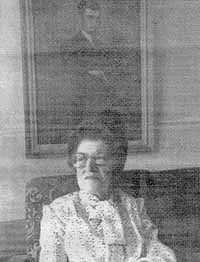
 - Would you tell us something about your father that is unknown or little known by the public?
- I suppose there are many unclarified and unpublished facts about the activities of my father but this is a task for the historians who now can freely use the secret archives. I can't talk about my father but I shall use the occasion to tell about his family about which, I think, little is known. Perhaps my story will be a little long and at times tedious but I can assure you that the life of the members of that family and ther descendants was not easy at all.
My father was born in Shtip (the Novo Selo quarter) on 4 March 1881. His mother (grandma Maria) gave birth to 12 children from whom 7 survived - 6 girls and one son - Todor. His father (Alexander Poporushev) is the descendant of priests (pop Orush, pop Apostol and pop Kostadin). Very gifted grandpa Alexander graduated from school ahead of time and was appointed assistant to the teacher Josif Kovachev. In 1888 he left for Radovish where the Exarchate, having appreciated his abilities and his patriotism, sent him to be a teacher and to fight the protestant infiltration in the town. After the successful completion of the task Aleexander with his family (three of the children had been born) returned to Shtip where he became the head teacher. At that time there taught Dame Gruev and Gotse Delchev. Grandfather Alexander became a member of the IMRO and actively entered the revolutionary struggle. According to grandma Maria he was a kind person, modest, loved and respected by his fellow-citizens and students. At the age of 45 he died. It is suspected he was poisoned by his physician who was a Grecoman.
Grandma Maria, the mother of Todor Alexandrov, came from the notable family of the Hadjiyanevs. Intelligent and brave, she stoically endured her fate. As a widow she made all efforts to fulfil her husband's will to educated all of her children. That was the start of an exceptional chain of love and affection between all the sisters and their brother.
The oldest sister Ekaterina, already graduated from the Solun Girls' High School and a teacher in Kochani, helped my father finish the Skopje Pedagogical Gymnasium and supported her sister Sophia. Later they helped Vasilka and Elena who in their turn supported Kira and Kostadina. This way all the six sisters graduated from the famous Solun Girls' Gymnasium and became teachers.
Troubled were the years for my father's family. After his graduation from school he as a teacher became a revolutionary. At a search in his house in Kochani compromising documents were discovered. He was taked under custody in Skopje and sentenced to 5 years in the Skopje prison "Kurshumli Han" where he spent 13 months. The amnesty saved him from his sentence. For the 1904-05 school year he was appointed to be the head teacher in his birthplace where he continued his revolutionary activity. In December 1904 after a battle of the cheta of Mishe Razvigorov the authorites got hold of a letter, from which they learned that my father continued his "subversive" activity. Informed ahead of time, he ran away and in a few days joined the cheta of Mishe Razvigorov. This put an end to his legal life and started he worries of grandmother Maria about the life of her only son.
The worst times came durign the disarming action in 1908 after the coup of the Youn Turks.
One night Turkish soldiers stormed in our house and beat my grandmother in front of her two daughters, who were at home for vacation, and tried to make her tell where my father was. The courageous Bulgarian woman did not utter a sound. After three days the Turks set the house on fire from all sides. The neighbours cries woke them up and sleepy and bare-footed they jumped through the window as the staircase was already burning. All were scared but relatives came up who gave them shelter. Grandmother Maria understood that her remaining in Shtip is out of question and she left her native region never to see it again. She left for Istanbul to stay at her daughter Sophia's family and my aunts Kira and Kostadina returned to Solun to continue with their studies.
- We would like to hear more details about your family.
- I will dare say a few more words about my father's sisters who proudly wore the "stain" sister of Todor Alexandrov.
Ekaterina, the eldest sister, taught in Skopje and married Kosta Tsipushev. I consider it redundant to talk about the life and the suffering of this great Bulgarian. In his book "19 Years in the Serbian Prisons" he descibes it all in detail. In 1934 he was released and returned in Sofia to aunt Katerina and their daughter Maria.
I shall make a detour and tell you about something whch would have been amusing, was it not so tragic and exemplary of the times we lived through. During the census in 1946 a commission visited the Tsipushev family and insisted that they declare themselves "Macedonian" and not Bulgarians. Could a normal person ever think that Kosta Tsipushev, having gone through the hell of Serbian jails because he refuesd to deny his Bulgarian ethnicity, in "free" Bulgaria would be made to betray his people? This is both shameful and awful!
The second sister Sophia taught at Shtip, Kochani and Kratovo where she married Mihail Tsonev, who, like my father, joined the IMRO in 1897 sworn by Hristo Matov. A loyal aide of my father and later of Ivan Mihajlov. They had 5 children who endured lots of hardships because of their father and their uncle. The oldest son Nikola was sent to prison camp.
Vasilka, the third sister, taught at Vinitsa, St. Nikole and Chorlu. She was married in Gorna Djumaja to Toma Panushev - a bank clerk. They 4 children who had a hard time as nephews of Todor Alexandrov.
The fourth sister Elena taught in Shtip and Istanbul. She married in Novi Pazar Lyuben Zafirov, a well-known lawyer and an ex-mayor of the town. Tried by the "People's Court" and acquitted. His whole property was confiscated. They had two daughters.
Next comes the fifth sister. Kira taught for a few years in Novi Pazar. In 1923 she was appointed a teacher in the Bulgarian school "Exarch Josiph" in Istanbul. She became the chairwoman of the "Radost" society the main task of which was to unite all Bulgarian immigrants from Bulgaria and Macedonia in one big family. She married Yanko Dimitrov from Zagorichani.
In 1945 she was fired as a ssiter of Todor Alexandrov and left without a pension. Nevertheless, she continued with the same enthusiasm her chairwoman's duties until 1966 when she finally left Istanbul for Sofia. She died in 1982, a most respected person.
After her departure from Istanbul the society elected her as an honorary chairwoman.
On her 70th anniversary (1909-1979) the leaders sent her the following greeting:
Dear Ms. Alexandrova,The saddest memories are about the youngest sister of my father. Kostadina taught at Strumitsa, Kochani and Gorna Djumaya from where after the murder of my father she moved to Sofia. For twenty years she was a teacher in the "Patriarch Evtimij" school where 9 September 1944 found her. En excellent pedagogue whe was loved and respected by her students and their parents. As a good patriot she enterned the Macedonian Women's Union and was in the leadership of the Shtip brotherhood as one of its founders.
You were the society's main support for more than 40 years. Thanks to your work it managed to survive for 70 years.
You were the doyen of our colony and did a lot of things for its cultural and educational progress.
Please accept our gratitude for all you have done for us.
We wish you good health and a long life!
Yours faithfully,
The "Radost" society
In the beginnign of 1945 as a sister of Todor Alexandrov she was fired. She was only 49 and there was only a year left till pension. This was not enough for her torturers. Soon after she was interned in Novi Pazar where she spent some harsh years.
One Easter night afte she was back from church in the home of her sister came two armed and two other people. They made a thorough search but found nothing "dangerous". They arrested aunt Kostadina and laughed at her relatives' request to give her warm clothes.
That is when her worst suffering began. Three months she spent in the basement of the 5th police department with the constant dread of rats and midnight interrogations. Not broken by the inhuman consitions she was sent to Belene for two years. Aunt Kostadina used not to talk about those times. More detail can be learned from the article of V. Gancheva in "Sofijski Vesti" from 21 June 1990 in which Tsvetana Draganova, a former inmate, tells the following: "Special attention (in the form of pressure) was payed to the sister of the famous leader Todor Alexandrov. Poor woman, she was wasting away before my eyes but remained firm and did not sign!"
On 8 March 1985 aunt Kostadina passed away. The ordeals did not kill her faith that the work for which her brother and thousands of other fighters for Macedonia gave their lives will one day triumph and be finished. She was happy that her students had not forgotten her and often visited her.
This is what I wanted to tell you about my dear one who lived honourably and remained true to their family.